
How to Know if You Have Bats in Your Attic
If you think you have bats in your attic, the first question is usually not how to get rid of them. The first question is how to know for sure it is bats and not mice, squirrels, or something else moving around above the ceiling. That matters, because bat work is completely different from rodent work. Bats are not trapped and removed the same way, they are not sealed out the same way, and the timing of a bat job matters a lot more than most homeowners realize.
At RF Wildlife, a lot of the bat calls I get start the same way: slow movement in a wall, squeaking near the ceiling, stains outside near the roofline, or droppings showing up below a high gap on the house. Sometimes the homeowner has been told it is mice. Sometimes they are sure it is squirrels. A good inspection usually tells the story pretty fast if you know what to look for.
If you are hearing noises in the ceiling, finding droppings in the attic, or seeing staining and guano outside the house, call or text RF Wildlife at 860-510-6313.
If you already know you have bats and need removal, see our Connecticut bat removal and exclusion services page for full details on how the process works.
Signs you may have bats in the attic
The biggest giveaway is often not seeing a bat at all. Most of the time, what people notice first is evidence around the house or subtle noises at the wrong time of day. Bats are quiet compared to squirrels, but they are not silent. Once you know the signs, attic bats get easier to recognize.
- Summer staining and guano outside near an entry point
- Small droppings on siding, decks, porches, windowsills, or the ground below the roofline
- Slow movement or light squeaking in a wall, ceiling, or soffit
- Droppings in the attic, especially near the outer edges or below vents
- Bats seen flying out of the house at dusk
- A strong attic odor on larger colonies
Look for staining and guano outside first
One of the best ways to tell if you have bats is to look on the outside of the house for staining and droppings near the entry point. In summer this is often easiest to spot because the colony is active, the weather is dry, and fresh guano stands out better on siding, stone, trim, and roofing.
Bat entry points are usually high on the structure. Common areas include roof edges, soffits, dormers, ridge vents, attic vents, fascia gaps, flashing lines, and places where trim meets masonry. The active holes often show dark staining from body oils along with droppings stuck below the opening or piled on surfaces underneath.
If your house has a chimney on an outside wall, check the thickest part where the brick or bluestone juts out. A lot of times you will find guano collecting on that ledge or on the siding below it, often around eight feet up or higher. That is a classic clue that bats are slipping into a gap nearby and using that projection as a place where droppings collect and become easier to see.

What bat noises sound like in a wall or ceiling
Another big clue is the kind of noise you hear. Bat noises are usually lighter and slower than squirrel noises. Homeowners often describe it as occasional movement, faint scratching, rustling, or squeaking. A lot of people assume squeaking automatically means mice, but mice rarely squeak enough for a homeowner to notice them inside a wall or ceiling. Bats squeak all the time, especially in a colony.
The location and response can help you tell the difference too. Squirrels are usually louder, faster, and heavier. They run. They make sharp bursts of movement. Mice tend to stay hidden and freeze when disturbed. Bats are different. If you bang on the wall or ceiling where the sound is coming from, mice often stop. Squirrels usually bolt. Bats often do not care much at all. If it is a roost spot, they may keep squeaking or shifting around like nothing happened.
That does not mean every squeak is a bat, but when you combine ceiling or wall squeaking with outside staining, guano, and activity near dusk, the picture starts to come together fast.
How to tell bat droppings from mouse or squirrel droppings
Bat guano is one of the most useful clues during an inspection. In the attic, it often collects along the outer edges, below roof transitions, beneath vents, or directly under the area where the colony is roosting. On the outside of the house, it may show up below the active entry point on siding, decks, chimney projections, window trim, or the ground.
The easiest field test is simple: crush it. If you crush bat guano, it turns to powder. Mouse droppings and squirrel droppings do not do that. Bat droppings are brittle because they are made up largely of insect remains. When you pinch older guano, it breaks apart easily. That difference alone solves a lot of inspections.
Big brown bat droppings are usually larger than mouse droppings and can be roughly about a quarter inch to three-eighths of an inch long, sometimes a little more depending on diet and moisture. They are dark, segmented, and crumbly when dry. Little brown bat droppings are much smaller and can look mouse-sized, which is where people get fooled. That is why shape and texture matter more than just size.
If you are in the attic and you find dark droppings but they turn to powder when crushed, that points strongly toward bats. If they stay firm, hard, and intact, you are more likely looking at mice or squirrels.
Once bats are confirmed, the next step is a proper exclusion. You can learn more about the full process on our bat removal and exclusion page.
Why attic bats are often mistaken for mice or squirrels
This happens all the time. If the colony is small, the sounds may be light enough that a homeowner assumes mice. If the bats are using a soffit return, dormer, or roof edge close to living space, the movement can sound heavier and people assume squirrels. The problem is that both guesses can send you in the wrong direction.
Bats do not chew into a house the way squirrels and mice do. They use existing construction gaps, lifted flashing, failed vents, warped trim, ridge vent voids, and openings made by age or prior animal damage. So if the noise is coming from high on the structure and the outside shows staining or guano near a narrow gap, bats move way up the list.
The other big difference is behavior. Squirrels are active and obvious. Mice are secretive and small. Bats tend to roost quietly for long periods, then become more noticeable near dusk as they shift, squeak, and prepare to leave. If the house suddenly gets noisier in the evening, that is another clue.
Where bats get into attics
Finding the entry point is the trickiest part of bat work and also the part that separates a real bat exclusion from guesswork. Most bat entry points are not huge holes. They are narrow construction gaps high on the house where several building materials come together.
- Soffits and fascia lines
- Dormer returns
- Attic vents and gable vents
- Ridge vent ends and roofline gaps
- Chimney flashing areas
- Voids where siding or trim meets masonry
- Gaps at roof intersections
Older homes can be even trickier because wall voids and framing details sometimes let bats move farther into the structure than you would expect. You may see the evidence outside in one spot and find the actual attic guano in another. That is why a good inspection has to connect the inside and outside signs together.

Attic vents are one of the biggest problem spots
Attic vents can be a challenge because once the screen is compromised, they act almost like a ready-made bat shelter. Sometimes a squirrel opened the vent first. Sometimes age, weather, or weak screening did the job. Either way, once bats find that protected void behind the vent, they may use it for a long time.
These spots often show exactly what you are looking for: staining, guano, and a high entry point that most homeowners would never inspect closely from the ground. A vent problem like this needs more than a patch. It has to be excluded and reinforced correctly so bats cannot keep using it and other animals cannot chew back in later.
What species are usually in Connecticut attics?
In Connecticut, the two bats most often involved in nuisance calls are the big brown bat and the little brown bat. Most attic bat jobs still tend to be big browns, but I am also seeing some little brown bat colonies, especially around the Madison and Guilford area. The little brown bat is important because the droppings can be small enough to fool people into thinking they are dealing with mice.
That is another reason you do not want to guess based only on droppings size. The location of the droppings, the outside staining, the evening behavior, and whether the droppings crush into powder all matter.
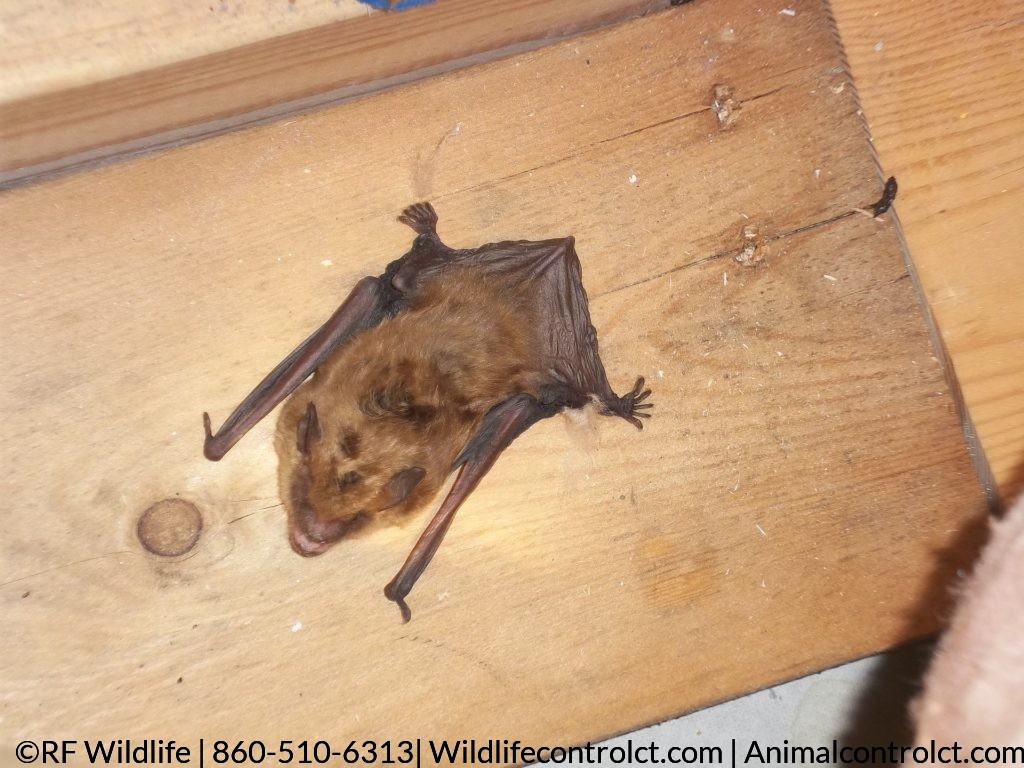
Summer bat activity and why timing matters
Summer is when a lot of homeowners first realize they have bats. That is because staining outside gets easier to see, droppings build up faster below active holes, and the colony becomes more noticeable in the evening. It is also the time of year when bats may be raising young inside the structure.
That is why bat work is not the same as sealing for squirrels or mice. If the timing is wrong, you can create a much bigger problem by locking flightless young inside. A proper inspection can tell you whether you are looking at an active summer colony, where the entry points are, and what the safe game plan is from there.
What to do if you think you have bats in the attic
Do not start stuffing holes with foam, hardware cloth, or whatever you have in the garage. Do not assume the opening you can see is the only one. And do not assume droppings automatically mean mice. Start with identification. Look for the outside clues, listen to the kind of noise you are hearing, and check the attic droppings carefully.
If you can safely observe the house at dusk, watch for bats dropping from a high gap and circling out from the structure. That can confirm the issue quickly. But even when you see that, the real work is figuring out all the other access points they could use once the exclusion starts.
RF Wildlife bat inspections and service area
RF Wildlife provides bat inspections, bat exclusion, and bat-proofing work across a large part of central and shoreline Connecticut. I serve all of Middlesex County, including Middletown, Portland, Cromwell, East Hampton, Haddam, East Haddam, Chester, Deep River, Essex, Westbrook, Clinton, Killingworth, Durham, Middlefield, Old Saybrook, and Old Lyme.
I also cover the east side of New Haven County up through Hamden and Cheshire, while skipping New Haven itself. That includes towns like Madison, Guilford, Branford, North Branford, Durham, Wallingford, North Haven, Hamden, and Cheshire.
Beyond that, I serve all of New London County, plus parts of Hartford County including Berlin, Southington, Farmington, Wethersfield, Rocky Hill, Glastonbury, and Marlborough.
If you are finding guano outside, hearing squeaking in the ceiling, or seeing signs of bats around the roofline, call or text 860-510-6313 to schedule an inspection with RF Wildlife.
Need help figuring out if it is bats?
If the signs point to bats, the sooner you identify the colony correctly, the easier it is to plan the job the right way. If it turns out to be mice or squirrels instead, that is good to know too. Either way, a real inspection beats guessing.
Call RF Wildlife at 860-510-6313 for attic bat inspections, bat exclusion, and bat-proofing in Connecticut.
If you’re seeing these signs and think you have bats, the next step is a proper inspection.
Call or text RF Wildlife at 860-510-6313 or visit our bat removal page to learn how the full exclusion process works.
